

Question. What should you name your resume?
I am applying to positions online and I need to submit a resume and cover letter. Is there a proper format for naming your resume? -- from Reddit
Naming your resume file might seem like a small detail, but it's one of the first things a recruiter sees, and it can shape their first impression of you.
After spending hours fine-tuning your resume to highlight your experience and skills, don't let a poor resume filename like "resume.pdf" hurt your chances. A clear, professional filename can help your application stand out, while a vague or messy one might make it look sloppy, misread by an ATS, or even entirely get lost in a sea of applications.
Not sure how to name your resume file properly? In this guide, we'll share practical tips, naming examples, and proven formats to help you choose the best file name for your resume. Let's get started on titling a resume file professionally.
Key Takeaways
- A clear and descriptive resume filename can help with a successful job application.
- Check the job description for any specific requirements for the resume filename and follow them.
- Use your first and last name to name the resume file, then add the job title, year, and the document type "resume, cover letter, etc." optionally.
- Use a hyphen or underscore to separate the word instead of spaces.
- PDF is always recommended for saving your resume unless otherwise specified.
- With JobHun's AI Resume Builder & Checker, you can easily create a professional resume with a perfect filename.
Why Naming Your Resume File Matters
Your resume file name might seem like a small detail, but it's actually the first thing recruiters see when they open your application. I've seen too many great candidates hurt their chances with sloppy file names.
Think about it from a recruiter's perspective. They're juggling dozens of applications for one position, and half of them are named "resume.pdf" or "untitled document." When they need to find your application later, which one do you think they'll remember - "resume.pdf" or "Sarah_Johnson_Marketing_Manager_Resume_2025.pdf"?
Here's what a good file name does for you:
Improves First Impression: It makes a solid first impression and shows you pay attention to details (something 68% of hiring managers actually care about, according to a 2024 TopResume survey).
Enhances ATS Compatibility: It also helps with those pesky ATS systems that many companies use—while they mainly scan your resume content, some still use file names to organize applications.
Avoids Confusion and Overwriting: Plus, you won't have to worry about your resume getting mixed up with someone else's when recruiters save multiple files to the same folder.
How to Name Your Resume File (Step-by-Step)
Naming your resume file properly isn't rocket science, but some tricks can make your application stand out. Here's exactly how to do it:

PRO TIP
Some employers may require specific file name formats, such as including a job ID number or a certain naming convention. In this case, always follow the instructions in the job description. If there is no specific requirement, follow the steps below to name your resume professionally.
Start with Your Full Name
Always lead with your first and last name exactly as they appear on your resume. This seems obvious, but you'd be surprised how many people skip this step.
Use underscores or hyphens to separate words instead of spaces. Spaces can cause headaches with some computer systems, and you don't want technical glitches preventing recruiters from opening your file.
So "Sarah_Johnson" or "Sarah-Johnson" works great, but "Sarah Johnson" might cause problems.
If you have a common name, consider adding your middle initial to help distinguish yourself from other candidates.
Add "Resume" (Not "CV")
Unless you're applying for academic positions or the job posting specifically asks for a "CV," stick with "Resume." It's more widely recognized in most industries, and it immediately tells the recruiter what they're looking at.
Place it right after your name: "Sarah_Johnson_Resume." Simple and clear.
Include the Job Title or Keywords
This is where you can really make your application shine. Add 1-2 keywords that match the position you're applying for. Look at the job posting and pull the exact title or key terms they use.
For example:
- "Sarah_Johnson_Marketing_Manager_Resume"
- "David_Lee_Software_Engineer_Resume"
- "Maria_Rodriguez_Graphic_Designer_Resume"
This does two things: it shows you're applying for a specific role (not just mass-applying everywhere), and it helps ATS systems connect your resume to the right job opening.
Consider Adding the Year (Optional)
Adding "2025" at the end shows your resume is current, which is especially helpful if you're job hunting over several months. It also helps you stay organized if you're applying to multiple positions.
Your file name might look like: "Sarah_Johnson_Marketing_Manager_Resume_2025"
Skip the year if you're applying immediately after creating the resume - it's not always necessary, just helpful.
Save as PDF (Usually)
Unless the job posting specifically asks for a Word document, go with PDF. PDFs keep your formatting intact no matter what device or system the recruiter uses, and most ATS systems handle them well.
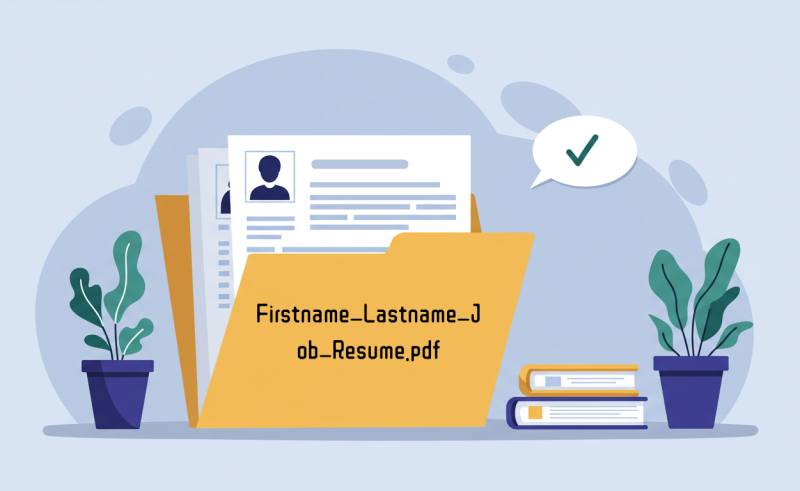
Your final file name should end with ".pdf" - so "Sarah_Johnson_Marketing_Manager_Resume_2025.pdf"
Double-Check Before Sending
Before you hit submit, take a quick look at your file name:
Make sure everything is spelled correctly, especially your name and the job title. Keep the total length reasonable - really long file names can get cut off in some systems. Avoid special characters like @, #, %, or & that might confuse computer systems.
By following these steps, you'll create a file name that's professional, searchable, and tailored to the job. Let's explore some tips to refine this process further.
Name It Right. Get It Right.
A well-named resume file is just the start. Build, polish, and check your resume professionally with JobHun. Our professional tools help you create the perfect resume file name to stand out for recruiters and ATS alike.

Tips for Naming Your Resume File (Dos & Don'ts)
To ensure your resume file name is recruiter-friendly, here are some key dos and don'ts to keep in mind:
Do:
- Use underscores (_) or hyphens (-) to separate words for clarity (e.g., "John_Smith_Resume.pdf").
- Keep it concise: 2-4 descriptive words plus your name (e.g., "Sarah_Lee_Sales_Resume_2025.pdf")
- Match the job title or industry to align with the role (e.g., "Emma_Wong_Graphic_Design_Resume.pdf").
- Double-check for typos to show you're detail-oriented.
Don't:
- Use spaces in the file name, as they can cause issues with some systems (e.g., avoid "John Smith Resume.pdf").
- Include special characters like @, #, or !, which can confuse ATS or file systems.
- Use vague names like "resume.pdf" or "final_version.docx" which lack context and look unprofessional.
- Include personal details like your phone number or address in the file name for privacy reasons.
These tips will help you avoid common pitfalls and keep your resume file polished and professional.
Best Resume File Name Formats
Not sure where to start? Here are some tried-and-true resume file name formats that work across industries:
Basic Format:

Template & Example
Template: [FirstName_LastName_Resume.pdf]
Example: Michael_Chen_Resume.pdf
Best for general applications.
Role-Specific Format:
Template & Example
Template: [FirstName_LastName_JobTitle_Resume.pdf]
Example: Lisa_Kim_Marketing_Resume.pdf
Tailored for target specific roles.
Year-Included Format:
Template & Example
Template: [FirstName_LastName_Resume_Year.pdf]
Example: David_Lopez_Resume_2025.pdf
Suitable for applying to multiple jobs over time.
Company-Specific Format:
Template & Example
Template: [FirstName_LastName_Company_Resume.pdf]
Example: Emily_Brown_Amazon_Resume.pdf
Use for different companies to show effort.
Choose a format that feels relevant to your application and aligns with the job posting's tone. If you're applying to multiple roles, tweak the job title or company name to tailor each submission.
Examples of Good vs. Bad Resume File Names
To illustrate what works (and what doesn't), here are some good and bad resume file name examples:
Good Example
Bad Example
From the above, you can see that good file names are clear, professional, and tailored for the role. They help recruiters quickly identify your information and the position you're applying for, even before opening your resume.
However, the bad resume filenames are too vague or overcomplicated for recruiters to review, or even contain special characters, making the ATS hard to read.
It's always better to take a moment to double-check yours before submitting.
What to Do If the Job Posting Specifies a Format
Some job postings include specific instructions for naming your resume file. Following these directions is crucial to show you can follow guidelines. Here's how to handle it:
- Read Carefully: Check the job posting or application portal for any naming requirements, like "LastName_FirstName_Resume.pdf" or "JobID_CandidateName.pdf."
- Follow Exactly: Use the exact format requested, including underscores, hyphens, or specific words like "CV" or "Application."
- Double-Check: If the instructions are unclear, mirror the example provided or contact the recruiter for clarification.
- Don't Overthink It: If no format is specified, use one of the standard formats above (e.g., "FirstName_LastName_Resume.pdf").
Adhering to specific instructions shows attention to detail and respect for the employer's process, so don't skip this step.
Bonus: How to Save and Format the Resume File
Beyond what to name your resume file, how you save and format your resume file also matters much. Here are some bonus resume tips to ensure your file is recruiter-ready:
- Save as a PDF: PDFs preserve formatting across devices and are ATS-friendly. Use software like Microsoft Word, Google Docs, or Canva to export your resume as a PDF.
- Check File Size: Keep your file under 2MB to avoid upload issues. Compress images or simplify designs if needed.
- Test Compatibility: Open your PDF on multiple devices to ensure fonts and formatting display correctly.
- Use a Clean Design: Avoid heavy graphics or unusual fonts that might not render properly in ATS or older systems.
- Name Consistently: If you're submitting a cover letter or other documents, use a similar naming convention (e.g., "Jane_Doe_Cover_Letter.pdf").
These steps ensure your resume is accessible and professional, complementing your carefully chosen file name.
Wrapping It Up
What should your resume file name be? With this blog, you should know that naming your resume file might seem like a small detail, but make a big difference. A clear, tailored name like "John_Doe_Data_Analyst_Resume_2025.pdf" helps recruiters find you, works with ATS, and shows you're organized. Pair it with a clean PDF, and your application is set to impress. Don't let a messy name like "resume.pdf" undo your hard work.
Follow the steps and tips in this guide to avoid common mistakes and ensure your application shines. Now, go to rename your resume file, double-check your resume, and apply with confidence!